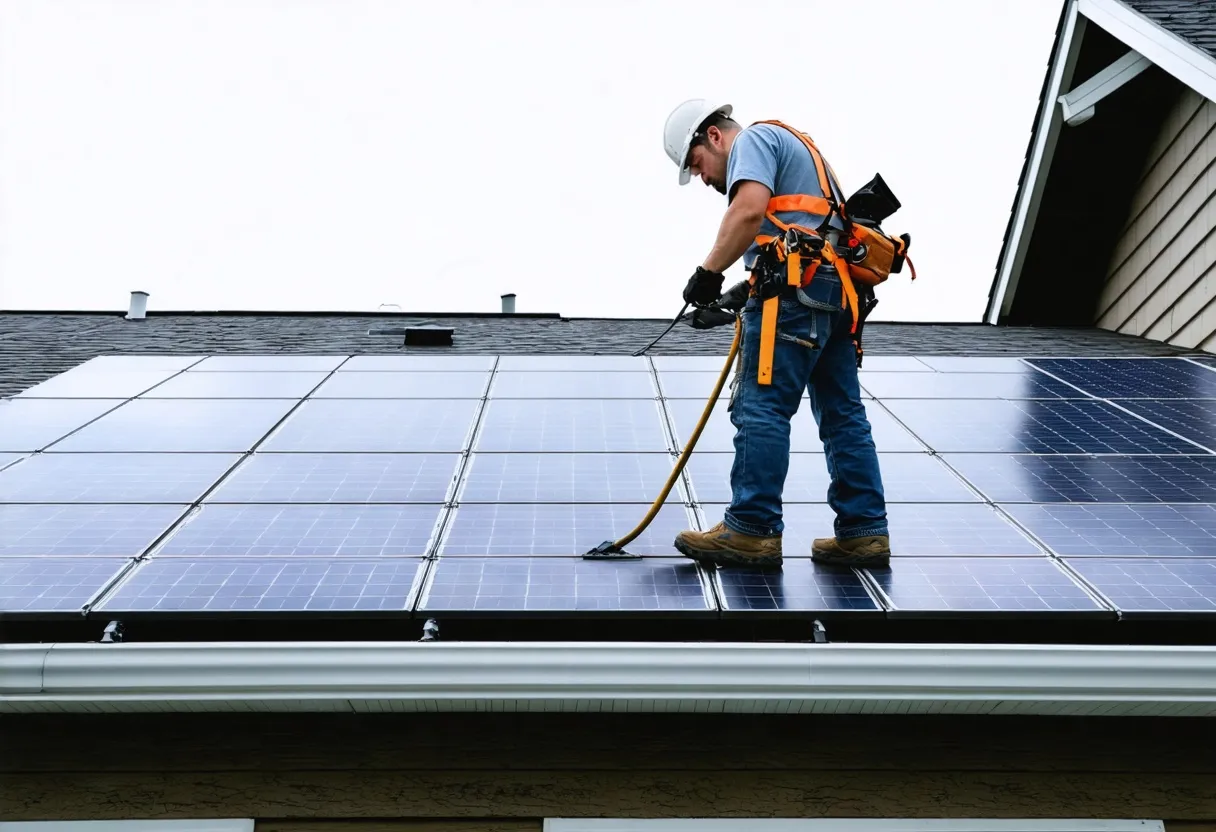
Search "Alaska solar tax credit" and you'll hit a wall fast: Alaska has no state income tax, so there is no state return for a state-level solar credit to reduce. That's not a loophole or an oversight — it's just how the state's tax code works, and it means every "top 10 state solar incentives" list that assumes every state runs like California or New York simply doesn't apply here. What Anchorage homeowners actually have to work with is a federal credit whose rules changed for 2026, net metering credits through Chugach Electric, occasional Anchorage Solarize group-buy pricing, and the avoided cost of grid electricity over the life of a system — which, for most Southcentral Alaska homes, ends up mattering more than any single credit ever did.
This page exists to give you the honest, current version of that picture, including the part that got less generous, and to connect it to something most incentive articles skip entirely: in Anchorage's climate, the size and engineering of your system determines how much of any incentive actually turns into real savings. A system that isn't sized for the winter daylight constraint or racked for real snow load can erase paper savings faster than any tax rule ever will.
Quick Answers Before You Read Further
Is there a separate Alaska state solar tax credit?
No. Alaska has no state income tax, so there is no state tax return for a state-level credit to reduce. Every dollar of incentive value available to an Anchorage homeowner comes from federal rules, utility net metering, or local group programs — never a state credit line item.
Is the federal solar tax credit still available for a system installed now?
Recent federal legislation ended the 30% Residential Clean Energy Credit for residential systems after it applied to installs placed in service on or before December 31, 2025. If your project is being installed now, don't budget around that credit until a CPA confirms your specific situation, since rules in this area have shifted quickly.
If my system went in during 2025, can I still claim the older credit?
Generally yes, on that year's tax return — talk to a CPA about filing Form 5695 or its current equivalent before you assume the window has closed. This is worth confirming directly rather than guessing based on when your install actually finished versus when it was contracted.
What's actually driving Anchorage solar savings now that the credit landscape has changed?
Net metering banking with Chugach Electric, the avoided cost of grid electricity over 25-plus years, and any active local group-purchase pricing through a program like Anchorage Solarize. None of these depend on a state credit that doesn't exist, and none of them are affected by the federal credit's new cutoff date.
Do rental or business-owned properties have different options?
Possibly — commercial energy credit pathways with their own phase-down schedules may still apply to business or rental property owners, but this is a CPA conversation specific to how the property is owned and used, not a blanket claim any installer should make on your behalf.
Does a well-engineered system matter more here than the incentive question?
In a lot of cases, yes. A system undersized for Anchorage's winter daylight or racked without real snow-load calculations will underperform regardless of what any tax rule allows, which means the engineering decisions upstream of your contract affect your payback period as much as the incentive rules do.
Why 'No State Income Tax' Means 'No State Solar Credit' Here
The confusion behind this search term is understandable, because most solar incentive content online is written for states that run a state income tax and use it as a policy lever — offering a percentage credit against what a homeowner owes the state each year. Alaska structurally can't do that. There's no state income tax return for a state solar credit to apply against, which means the entire premise behind a headline like "see if your state offers a solar tax credit" collapses the moment you plug in Alaska. It isn't that Alaska decided solar wasn't worth incentivizing at the state level; it's that the mechanism those other states use doesn't exist in Alaska's tax code at all.
That distinction matters because it changes what you should actually be researching. Instead of hunting for a state credit percentage that will never surface, the more useful question for an Anchorage homeowner is: what combination of federal rules, utility program structure, and local group-buy pricing actually applies to my project, on my install timeline? Those three levers — federal eligibility by install date, net metering credit banking with Chugach Electric, and whether an Anchorage Solarize cohort happens to be open — are the real incentive landscape here, and they behave very differently from a flat state credit percentage. Net metering credit value, for example, isn't a one-time number on a tax form; it accrues and rolls over across your production curve, which in Anchorage is heavily front-loaded toward summer. A Solarize discount, when available, reduces your upfront cost through bulk purchasing power rather than through the tax code at all, so it stacks differently than a credit would.
None of this means Anchorage solar is a worse financial decision than in a state with an income-tax-based credit — it means the math runs through different variables, and an installer or article that talks about Alaska solar incentives using Lower-48 assumptions is giving you the wrong framework before you've even gotten to numbers.
What Actually Counts as a Solar Incentive in Anchorage
How to Confirm Your Real Incentive Picture Before You Sign
Ask directly whether the December 31, 2025 cutoff and current Form 5695 rules apply to your project rather than relying on a general statement from a sales conversation.
A single recent bill tells an installer nothing about your winter-versus-summer load pattern, and that pattern is what any honest system sizing and net metering banking estimate has to be built around.
It's a rolling, not permanent, program, so timing determines whether it's available to you at all right now.
A realistic Anchorage quote should show a clear seasonal curve including a modest winter output, which tells you how much of your projected savings comes from banked net metering credits versus an assumption about a tax credit that may not apply.
If a quote verbally references a tax credit or program discount, get it documented in writing so you have recourse if the rule or program status changes before your project closes.
One Honest Rule of Thumb
If a quote states a specific tax credit percentage as guaranteed savings without telling you to confirm it with a CPA against your actual install date, treat that as marketing language, not a financial fact. Verify first — it can change your payback math by a meaningful margin either way.
How Winter Daylight and Snow-Load Engineering Protect Whatever Savings You Do Get
The part generic incentive content leaves out
Almost every national solar article treats system performance as a flat annual average, which is a reasonable shortcut in most of the Lower 48 and a genuinely misleading one in Anchorage. Southcentral Alaska's daylight swings dramatically across the year — long, bright summer days capable of producing more energy than a household uses in a day, and short winter days where the sun stays low on the horizon for only a few hours and panel output drops sharply. A system designed off a national average production model will overproduce in July and underdeliver right when heating-adjacent electric loads — furnace fans, block heaters, extra indoor lighting — are highest in December and January.
The reason this belongs on an incentive page rather than only a technical one is simple: no tax rule, net metering credit, or Solarize discount fixes an undersized or poorly oriented system. If your system doesn't build enough summer surplus to bank real net metering credits for the darker months, or if the panels are tilted for a manufacturer's default sun angle rather than Anchorage's actual latitude, you lose value regardless of which federal or local incentive did or didn't apply to your purchase. Sizing partly for net-metering banking — rather than expecting the panels themselves to carry winter loads directly — is what turns Anchorage's lopsided daylight curve into a manageable annual pattern instead of a January shortfall.
Snow load is the other half of the same conversation, and it's just as easy for an out-of-market installer to get wrong. Roof-mounted arrays here need racking rated for actual local snow-load requirements, hardware that accounts for ice damming at panel edges, and a tilt steep enough to help snow shed rather than sit and shade the array for weeks at a time. An array that holds snow through a January storm doesn't just look inconvenient — it loses production for days at exactly the point in the year when every kilowatt-hour matters most for your bill. The Municipality of Anchorage's own rooftop solar array is useful proof here, not as a marketing point but as real, publicly visible evidence that grid-tied solar performs across a full Anchorage year when it's engineered for the conditions rather than dropped in using assumptions from a milder climate.
Any installer quoting your project — including one working out of the Ingra St. area serving the broader Anchorage footprint — should be able to show you an actual monthly production model and a load calculation specific to your roof, not a generic manufacturer spec sheet. That's the detail that determines whether the incentive picture above translates into real savings on your electric bill or stays a number on a sales sheet.
Request your free quote
See what a winter-ready system would look like on your home, with no pressure to move forward.
Get a system built for Anchorage winters
Reach out for a no-obligation quote sized to your roof and this climate.